Is India on track to successfully develop Its indigenous Regional Transport Aircraft (RTA-90)?

RTA-90, India’s ambitious regional transport aircraft development program, is considered a major step toward achieving self-reliance in the aviation sector, as India continues to rely heavily on imports for commercial airliners. The program has received strong support from Indian aerospace giants CSIR-NAL and HAL (Hindustan Aeronautics Limited), with CSIR-NAL leading the design development activities and HAL handling manufacturing. But the programme continues to face several challenges, including visibility on the financial mechanism for design & development, overlooked requirement of a full-scale simulator, and the need for dedicated Flying Training Organizations (FTOs), and a definitive purchase commitment.
CSIR-National Aerospace Laboratory (NAL) had presented an approach paper for the Indigenous Regional Transport Aircraft (RTA-90) development Program on the sidelines of the Aero Show 2019. In February 2021, the program received in-principle approval from the Ministry of Science and Technology, the Ministry of Civil Aviation, the Ministry of Finance, and the Prime Minister’s Office to proceed with the design and development activities. The aim is to conclude the Preliminary Design Phase in 18 months, and the expected entry into service is from 2026 onwards.
The RTA-90 aircraft will have both turboprop and turbofan variants with a capacity of 90 passengers. The aircraft will have a range of 2500 km, a cruising altitude of 30000 feet, and the capability to operate from unpaved or semi-prepared runways. The features make it best suited to complement the Indian government initiative, the Regional Connectivity Scheme-UDAN (Ude Desh ka Aam Nagrik), with better operational and cost efficiency. The aircraft has also been able to attract the attention of the private sector players owing to increased demand for regional airliners fueled by the robust growth of the Indian aviation sector and the push on the RCS-UDAN.
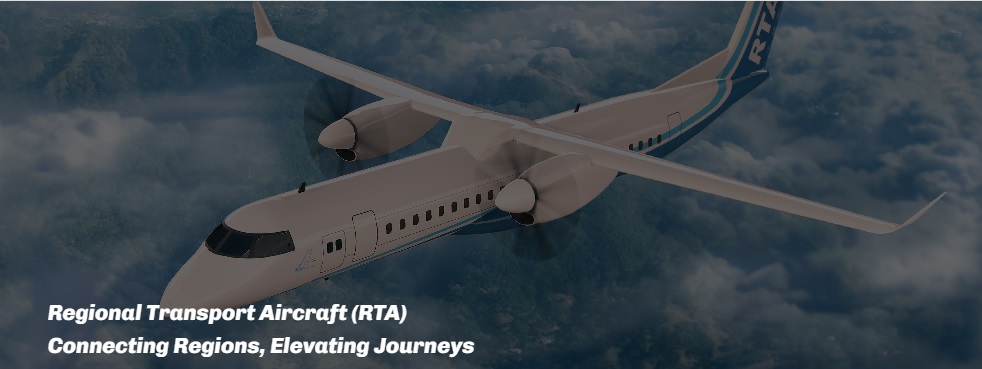
Photo credits: CSIR-NAL official website: CSIR-NAL’s Regional Transport Aircraft (RTA-90)
Media reports published in September 2024 suggest that the RTA-90 programme is nearing completion of the conceptual design programme, and the project definition phase is well underway. CSIR-NAL has proposed the development of seven (07) prototypes of the RTA-90 in different configurations and engine variants, aiming to cater to both civilian and military operators across diverse operational requirements. As the programme is ready to move into the preliminary design phase, CSIR-NAL has submitted the detailed project report to the Ministry of Civil Aviation and sought approximately USD 2 billion in funding to advance the RTA-90 project. Given that the RTA-90 is a clean-sheet design, the development process is expected to be highly capital-intensive, necessitating multiple cycles of design, analysis, and flight testing.
In September 2024, the RTA-90 aircraft project received a major boost when the Minister of Civil Aviation, Shri Ram Mohan Naidu, announced in the Rajya Sabha the establishment of a Special Purpose Vehicle (SPV). This SPV, an independent legal entity, will operate for five years and is tasked with overseeing the funding, design, development, certification, and marketing of the RTA-90. It will bring together key government agencies—including CSIR-NAL, HAL, and DRDO—alongside private domestic and international firms, as well as global OEMs specializing in engines and avionics. Notably, the SPV will not receive upfront funding; instead, financial support will be linked to achieving specific, predefined milestones.
While the government’s initiatives to support the RTA-90 programme are commendable, there has been little visible progress since the initial announcement in September 2024. No major developments have made headlines, raising concerns about the project’s momentum. Industry experts caution that, given the design and development complexities involved—especially for an aircraft of this scale being developed indigenously for the first time—such delays could significantly impact the programme’s timeline. More critically, prolonged inaction may erode the already cautious interest of private sector firms.
Industry experts further warn about the risks associated with the SPV when executing a complex, design-intensive program. Conflicts among SPV stakeholders concerning decision-making, IP ownership, funding shortfalls, cost overruns, and certification delays may disrupt the smooth execution of the program.
It would be a better option if the programme gets the initial financial support from the government in the form of grants or subsidies. Such precedents are available in aviation history, where Boeing and Airbus have both received substantial funding and subsidies from their respective governments over the years to support their ambitious commercial aircraft programs.
One crucial aspect of the programme that seems to have been overlooked is the plan to develop a full flight simulator (FFS) for the aircraft. This will be essential later when preparing the aircraft for certification, pilot training, and entry into service. A full flight simulator is an indispensable part of pilot training and requires planning, time, cost, and resource engagement from the initial stage of aircraft development. Additionally, a plan for establishing dedicated Flying Training Organizations (FTOs) for the RTA-90 aircraft needs to be formulated. This will require significant investment from private sector firms, who can only be expected to commit if there is clear visibility on purchase order commitments.
Despite the significant challenges related to funding, establishing supporting infrastructure like dedicated Flying Training Organizations (FTOs), and securing firm purchase order commitments, the development of the RTA-90 remains a strategically crucial initiative for improving regional connectivity and strengthening domestic aerospace capabilities. To ensure its successful implementation, a coordinated approach involving strong policy support, early engagement with private stakeholders, and clear visibility on long-term procurement plans is essential. With the right alignment of government backing, industry participation, and timely investment, the RTA-90 program can overcome current hurdles and play a transformative role in India’s regional aviation landscape.
