India’s small aircraft sector – on the brink of a long-awaited liftoff

India’s aviation sector has emerged as the world’s third-largest civil aviation market in the current year 2025. In the booming aviation sector, the small aircraft business segment is expected to see a breakthrough on the underserved domestic routes, driven by expanding airport infrastructure and a growing middle class.
Indian aviation market is soaring high, driven by historic growth in both domestic as well as international air travel. The International Air Transport Association (IATA) report reveals that India is now become a third-largest aviation market in terms of passenger traffic and the sixth-largest for air cargo. As per research report of Mordor Intelligence, the Indian aviation market is estimated to be valued at USD 14.78 billion in 2025 and is projected to reach USD 26.08 billion by 2030, growing at a compound annual growth rate (CAGR) of 12.03% during the forecast period (2025–2030). This unprecedented growth is attributed to fusion of factors like rise in stronger airlines, increased domestic connectivity, and enhanced aviation infrastructure across regions.
This blog explores the driving forces and challenges for the small aircraft business segment on the heels of booming Indian aviation sector.
What qualifies an aircraft as ‘small’ in the aviation industry?
An aircraft, that is light weight, carries 19 or less passengers, and finds utility in short domestic flights, air taxi services, air ambulance, private or business aviation etc.
Key Enablers:
- Regional Connectivity
The Government of India’s regional connectivity scheme, UDAN (Ude Desh ka Aam Naagrik), aims to make air travel affordable and accessible to all citizens while enhancing connectivity to underserved and remote regions. As on date, 90 regional airports have been operationalized under the UDAN scheme connecting 625 routes. The initiative has opened new opportunities for small aircraft to operate on short-haul domestic routes, leveraging their operational flexibility and cost-efficiency. India’s state owned aviation giant Hindustan Aeronautics Limited (HAL) has rolled out its first civil small aircraft “Hindustan 228” under the nod of civil aviation authority, DGCA. The Hindustan 228 aircraft has a maximum passenger capacity of 19 and features Short Take-Off and Landing (STOL) capability. It is specifically designed for operations from semi-paved airstrips. These characteristics make it an ideal choice for operations in geographically diverse regional airports with limited infrastructure. The aircraft is eyeing a big pie of the booming industry, but set to get a competition from France-based turboprop aircraft manufacturer ATR.
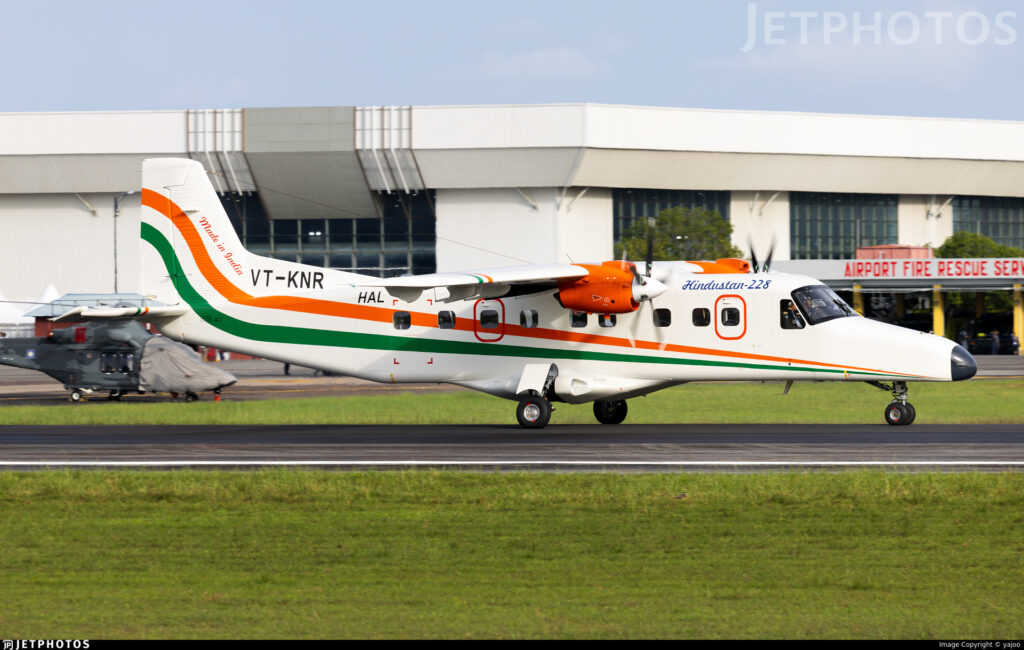
Hindustan Aeronautics Limited’s Hindustan 228, India’s first homegrown type certified aircraft by DGCA.
- India’s Growing Middle Class
IndiGo, India’s largest Low cost carrier (LCC) earns 86% of its revenue from the domestic operations and betting its future growth on estimated projection of doubling of middle class population from 158m to 300m in the period of 12 years from 2018 to 2030. This demographic shift is expected to increase the disposable income, increased tourism, air sports adventures culminating the growth of small aircraft business segment.
- Emerging small aircraft industry
Encouraged by the Government of India’s regional connectivity push and huge investment in airport infrastructure development, companies like Thrust Aircraft Pvt. Ltd, Raj Hamsa Ultrlights are developing and manufacturing small aircraft.
Challenges:
- Regulatory Framework
The small aircraft have to go through same complex process of certification as of the large aircraft with certification agencies, which becomes un-necessarily cumbersome for small industries and airlines taking up either development or operation. The lack of tailored regulatory requirements sometimes proved to be discouraging for indigenous developers and manufacturers.
- Demand- Supply Gap
Despite financial support provided by government to airlines as viability gap funding and airport fee concessions provided by Airport Authority of India (AAI) on some of the RCS routes, it is becoming difficult for airlines to operate on low demand routes with low passenger traffic. This is constraining airlines to adopt and expending small aircraft business, as these make up new a fleet of aircraft to maintained with less financial viability and additional infrastructure investment.
- Pilots Reluctance
Although, there is overall shortage of pilots in India, pilots are specifically reluctant to take up small aircraft jobs due to high training cost, limited job opportunities, and perceived lack of career progression compared to commercial airline pilots. The pilots’ hesitancy towards small aircraft jobs is hindering the flourishment of this business segment in India.
Conclusion
The government’s initiatives towards development of regional connectivity and the increase in population of middle class fueled by robust economic growth have given real initial boost to small aircraft business. However, the small business segment requires addressing of multiple policy related improvements like streamlining of certification, pilot training, norms for leasing small aircraft, setting up of MRO facilities near regional airports, and increasing viability gap funding. The small aircraft business is ready to soar, fueled by the rapid expansion of India’s aviation sector, proactive government policies, and backing from airline industry leaders.
